
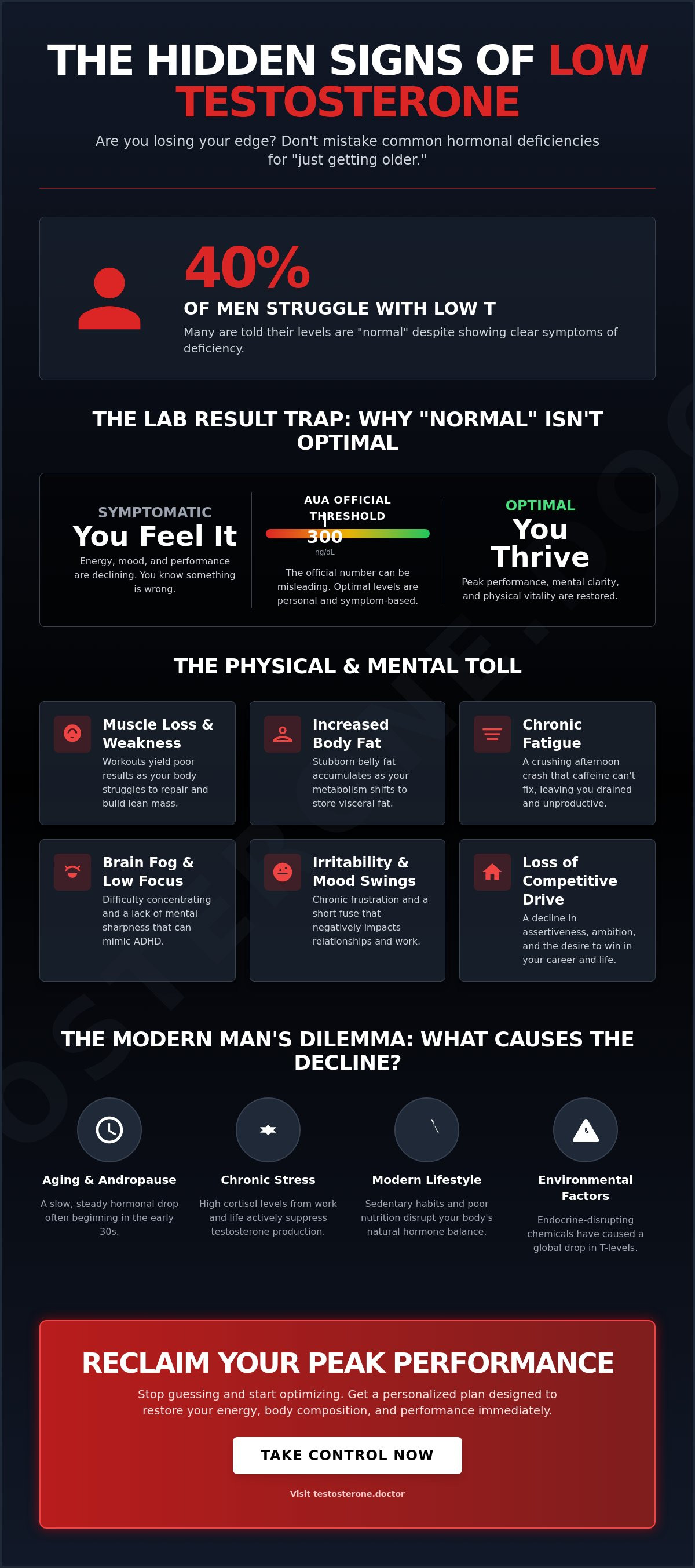
Are you feeling "off?" That nagging sense of exhaustion, the mental fog that clouds your focus, the frustrating loss of drive in the gym and at work—it's easy to dismiss these feelings as just "getting older." But what if it's not? For many men in their 30s, 40s, and 50s, these are the first warning signs of declining testosterone.
This isn't just about libido. Low testosterone (Low T) is a drain on your vitality, performance, and overall health. It's the hidden variable that can make you feel like you're fighting an uphill battle against your own body. This guide will expose the real low testosterone symptoms in men and explain why your "normal" lab results might be failing you.
Table of Contents
-
Recognizing Low Testosterone Symptoms in Men: Are You Losing Your Edge?
-
The Physical and Sexual Toll: How Low T Attacks Your Strength and Stamina
-
The Lab Result Trap: Why 'Normal' Levels Aren't Always Optimal
Recognizing Low Testosterone Symptoms in Men and Women: Are You Losing Your Edge?
Low testosterone isn't an overnight event; it's a gradual decline that chips away at your performance. The symptoms often creep in so slowly that you write them off as stress or a natural part of aging. But the reality is that modern environmental and lifestyle factors are causing this decline, often called 'Andropause,' to hit men earlier than ever before.
Think of testosterone as your biological engine for drive, focus, and strength. When the fuel line gets clogged, the entire system sputters. Recognizing the signs is the first step to refilling the tank. (Understanding Hypogonadism (Low Testosterone))
What is Male Hypogonadism?
Clinically, Low T is known as male hypogonadism. This condition occurs when your body isn't producing enough testosterone, either due to an issue with the testicles (primary hypogonadism) or a signaling problem from the brain's pituitary gland (secondary hypogonadism). Your endocrine system is a complex network, and when the signals get crossed, production drops. But it's crucial to understand this: hypogonadism is a treatable medical imbalance, not a permanent loss of manhood.
Andropause in Layton: Fact vs. Fiction
There's a common myth that "male menopause" isn't a real thing. It is. Andropause is the term for the age-related decline in testosterone, and it's a documented medical reality. For men in Layton, particularly those in high-stress, high-performance careers, the constant pressure can accelerate this hormonal decline. Your body diverts resources to manage stress, often at the expense of testosterone production. For a deeper dive into this local issue, read our guide: Andropause in Layton: Is "Male Menopause" Fact or Fiction in 2026?
The Physical and Sexual Toll: How Low T Attacks Your Strength and Stamina
The most noticeable low testosterone symptoms in men are often physical. You feel it in the gym, you see it in the mirror, and you notice it in the bedroom. This isn't a lack of effort—it's a change in your body's fundamental chemistry.
-
Muscle Atrophy: Are you working harder at the gym but seeing fewer results or even losing muscle mass? Low T directly impacts your body's ability to build and maintain lean muscle.
-
Visceral Fat: That stubborn belly fat that seems impossible to lose is strongly linked to low testosterone. It's not just a cosmetic issue; this type of fat is dangerous for your metabolic health.
-
Sexual Performance Issues: It's more than just a low libido. Men with Low T often experience a decline in erection quality, reduced morning erections, and a decrease in semen volume.
-
Chronic Fatigue: This is the bone-deep exhaustion that sleep and caffeine can't fix. The classic "afternoon crash" is a hallmark sign of a hormonal imbalance.
Body Composition and Metabolic Health
Testosterone is a master regulator of your metabolism. It tells your body to burn fat and build muscle. When levels drop, that signal gets weaker, leading to a vicious cycle: weight gain (especially visceral fat) further suppresses testosterone production, making it even harder to get back in shape. Optimizing your hormones is often the key to breaking this cycle. Our targeted medical weight loss programs can work alongside TRT to accelerate your results. (symptoms of low testosterone)
Sexual Performance and Vitality
Erectile Dysfunction (ED) is one of the most common reasons men seek help, and it's often a direct symptom of Low T. However, before starting treatment, it's vital to get a complete picture of your health. A key at-home indicator of your hormonal health is the frequency and quality of "morning wood." If it's become a rare occurrence, it's a strong signal that your testosterone levels may be suboptimal.
The Mental Fog: Why Low Testosterone Feels Like ADHD
The impact of Low T goes far beyond the physical. Many men are shocked to learn that their mental struggles—the brain fog, irritability, and lack of focus—are directly tied to their hormones. Traditional medicine often overlooks this connection, misdiagnosing a hormonal problem as a purely psychological one.
-
Brain Fog: The frustrating inability to concentrate on complex tasks, recall information, or stay sharp in meetings.
-
Irritability and Mood Swings: Do you find yourself with a shorter fuse? This "grumpy old man" syndrome can strain relationships and is often caused by hormonal fluctuations.
-
The ADHD Connection: Many men in their 30s and 40s are diagnosed with adult ADHD when the root cause is actually Low T. The symptoms of poor executive function and lack of motivation are nearly identical.
-
Sleep Disturbances: Low testosterone can disrupt deep sleep cycles, leading to insomnia or waking up feeling like you haven't slept at all.
Cognitive Decline and Focus Issues
Testosterone plays a crucial role in neurotransmitter function, which governs your focus, memory, and motivation. When levels are low, your cognitive horsepower sputters. If you're a man over 30 experiencing new or worsening focus issues, a hormone check should be your first step. At Testosterone.Doctor, we offer specialized ADHD consultations to determine if your symptoms are hormonal, neurological, or both, ensuring you get the right treatment plan.
Mood Regulation and Anxiety
Low testosterone is often linked to elevated levels of cortisol, the body's primary stress hormone. This imbalance can lead to feelings of anxiety, mild depression, and social withdrawal. For many of our patients, restoring their testosterone to optimal levels provides significant relief from these mood-related symptoms. We believe that for men, mental wellness often starts with hormonal balance.
The Lab Result Trap: Why 'Normal' Levels Aren't Always Optimal
This is the most frustrating hurdle for men seeking help. You feel terrible, you have all the classic low testosterone symptoms, but your doctor runs a blood test and tells you you're "normal." This happens every single day because the standard lab reference ranges are deeply flawed.
-
The Reference Range Problem: The "normal" range (typically 300-1,000 ng/dL) is an average of all men tested, including the sick, the elderly, and the sedentary. Being in the bottom 10% of that range is not "normal" for a healthy, active man.
-
Total vs. Free Testosterone: Your total testosterone is just a number. What really matters is your free testosterone—the amount your body can actually use. You can have a "normal" total T level but still feel awful because most of it is bound and unavailable.
-
The '400 ng/dL' Dilemma: A 35-year-old man with a testosterone level of 400 ng/dL will often be told he is fine. But his level may have been 900 ng/dL just a few years earlier. That 50% drop is what causes severe symptoms, even though he is still technically "in range."
Understanding Your Bloodwork
When you look at your lab results, don't just accept "normal." We focus on getting our patients into the optimal range for their age and lifestyle, which is often 800-1,000 ng/dL or higher. It's about how you feel, not what a flawed chart says. We analyze both your Total and Free Testosterone to understand what your body can actually use, giving us a true picture of your hormonal health.
Why Your General Doctor Might Be Missing the Signs
Most primary care physicians are not specialists in hormone optimization. They are trained to look for disease, not to optimize for peak performance. They often rely on outdated guidelines and may carry a bias against Testosterone Replacement Therapy (TRT). A specialist clinic like Testosterone.Doctor is dedicated to performance medicine. We understand the nuances of hormone balance and are focused on one thing: getting you results.
Reclaiming Your Peak Performance: The Layton Solution
Stop accepting fatigue, brain fog, and a loss of drive as your new normal. Waiting to feel even worse is a losing strategy. It's time to take control of your health and reclaim the energy and focus you've lost.
-
The Testosterone.Doctor Advantage: You get personalized, expert care from a specialist focused on hormone optimization, right here in Layton.
-
Confidentiality and Speed: We offer fast, discreet testing and results without the bureaucratic red tape of a hospital system.
-
The $99/Month Exclusive Membership****: We've made elite-level health optimization simple and affordable for every man who wants to perform at his best.
How to Get Started Today
Our process is designed to be fast, simple, and effective. It's just three steps: an initial consultation, comprehensive lab work, and a personalized treatment protocol designed to meet your specific goals. We are a specialized clinic and do not offer general primary care, which allows us to focus 100% on your optimization. Because we don't bill insurance directly, we work for you—not an insurance company—ensuring you get the best possible care without interference.
Join the Membership
Our $99/Month Exclusive Membership isn't just a treatment; it's a recurring investment in your health, performance, and quality of life. We offer a no-nonsense, results-driven approach to performance medicine for men and women who are ready to stop feeling "fine" and start feeling fantastic. Don't wait another day to get your edge back.
SIGN ME UP! Get started with Testosterone.Doctor today!
Frequently Asked Questions
-
What are the very first signs of low testosterone in men? The earliest signs are often subtle and non-sexual. They typically include persistent fatigue (especially afternoon crashes), a noticeable drop in motivation or competitive drive, and increased difficulty concentrating or "brain fog."
-
Can I have low testosterone symptoms if my lab results are 'normal'? Absolutely. This is extremely common. The "normal" lab range is very wide and includes unhealthy individuals. A man can have severe symptoms with a level of 400 or 500 ng/dL if his optimal level is much higher. We treat the patient and their symptoms, not just the lab number.
-
Is 400 ng/dL considered low testosterone for a 35-year-old? While a general practitioner might call it "low normal," for a healthy 35-year-old, it is suboptimal and likely the cause of significant symptoms. A man in his prime should ideally be in the upper end of the reference range (800-1000+ ng/dL) to feel and perform his best.
-
How fast will I feel the results of testosterone therapy? Many patients report improvements in energy, mood, and mental clarity within the first 2-4 weeks. Physical changes, such as increased muscle mass and fat loss, typically become more noticeable after 2-3 months of consistent treatment.
-
Will TRT help with my brain fog and lack of focus? Yes, for many men, this is one of the most significant benefits. By restoring testosterone to optimal levels, TRT can dramatically improve cognitive function, memory, and the ability to concentrate, often resolving symptoms that mimic adult ADHD.
-
Do I need a referral from my primary care doctor to visit your Layton clinic? No, you do not need a referral. You can schedule a consultation directly with us to get started on your optimization journey quickly and efficiently.
-
Is your testosterone testing confidential? Yes. All of our consultations, lab work, and treatments are 100% confidential and handled with the utmost discretion in a professional medical environment.
-
What happens if I ignore the symptoms of low testosterone? Ignoring the symptoms allows the problem to worsen. Over time, untreated low testosterone can contribute to more serious health issues, including obesity, metabolic syndrome, osteoporosis, cardiovascular problems, and a progressively declining quality of life.
Article by
Timothy Coltrin
Disclaimer
"Results May Vary" results are not guaranteed and will vary between individuals.