You aren't just tired because you trained hard; you're crashing because your internal chemistry is waving a white flag. It's a frustrating reality when you put in the work but see your muscle mass softening and your motivation in the gym evaporating. You know that recovery and hormone balance for athletes is about more than just taking a rest day, yet the lingering joint pain and brain fog suggest your body isn't bouncing back like it used to. It's time to stop guessing and start looking at the clinical data behind your performance.
We agree that feeling like a shell of yourself despite eight hours of sleep is unacceptable for anyone serious about their goals. This article will teach you how to medically optimize your hormonal recovery to stop the crash and start dominating your training again. We'll dive into the science of cortisol management, the 2026 landscape of real-time hormone monitoring, and the medical pathways like TRT and peptides that provide a clear path to optimization. You'll get the scientific validation you've been looking for and a strategy to restore your mental clarity and physical edge. Let's get to work!
Key Takeaways
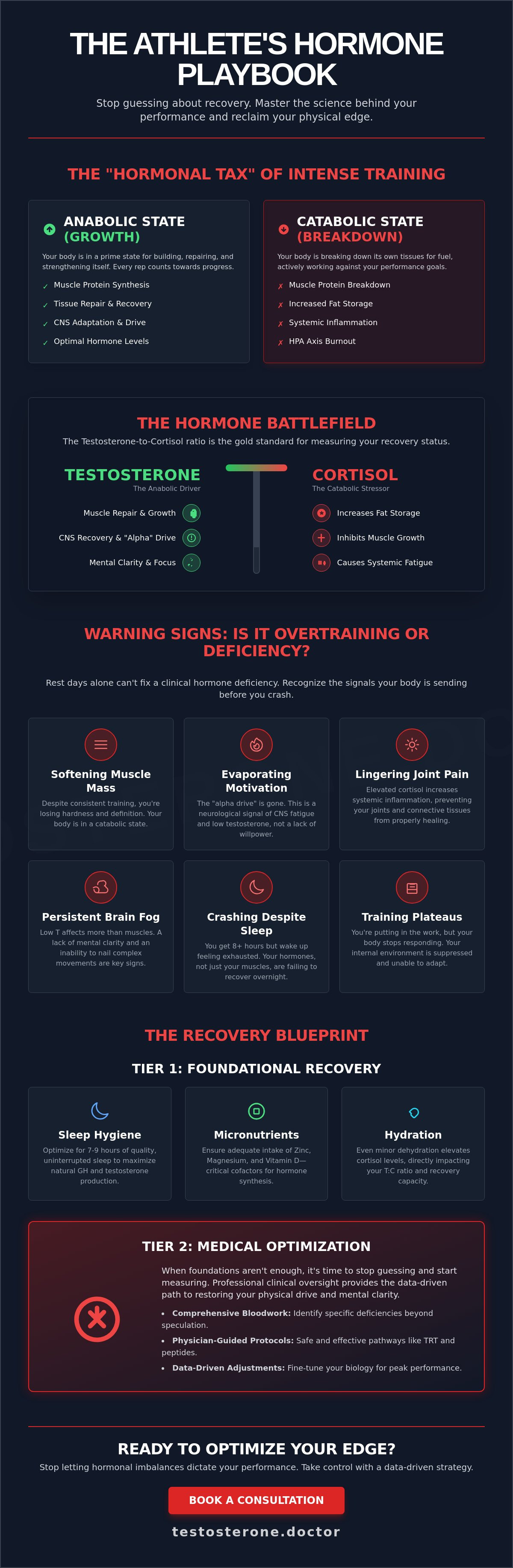
- Understand the "Hormonal Tax" and how intense training shifts your body from an anabolic building phase into a destructive catabolic state.
- Discover why recovery and hormone balance for athletes depends on the critical balance between muscle-repairing testosterone and fat-storing cortisol.
- Learn to identify the difference between simple overtraining and clinical hormone deficiencies that rest days alone cannot fix.
- Master the "Big Three" of recovery—sleep, micronutrients, and hydration—while using periodization to protect your HPA axis from burnout.
- Explore how medical optimization through professional clinical oversight can help you regain mental clarity and restore your physical drive.
##Table of Contents
-
The Hormonal Tax: Why High-Performance Training Demands More Than Rest
-
Decoding the Athlete’s Endocrine System: Testosterone, Cortisol, and GH
-
Strategic Recovery: From Sleep Hygiene to Medical Optimization
##The Hormonal Tax: Why High-Performance Training Demands More Than Rest
You hit the gym, track, or field with everything you've got. You expect your body to pay you back in muscle, power, and speed. But high-volume training levies a systemic depletion of endocrine resources that we call the "Hormonal Tax." It's the physiological price your body pays for peak performance. Most athletes think a Sunday on the couch is enough to maintain recovery and hormone balance for athletes. They're wrong.
When you train at an elite level, your body shifts from an anabolic building state to a catabolic breakdown state. This isn't just about sore muscles; it's about your entire internal system running in the red. Passive rest won't fix a metabolic environment that's actively working against you. You need a proactive strategy to balance the books.
To better understand the biological mechanisms at play, watch this expert breakdown:
Gritting it out is the fastest way to accelerate your hormonal decline. Pushing through chronic fatigue doesn't make you tougher; it just deepens the deficit. Medical optimization is the solution for the modern athlete who refuses to settle for "average" recovery. You must manage the biological cost of your ambition if you want to stay in the game.
The Fight-or-Flight Trap
Your body doesn't know the difference between a heavy squat session and running from a predator. Chronic sympathetic nervous system activation keeps you in a permanent state of high alert. This constant stress suppresses your natural testosterone production because your body prioritizes immediate survival over long-term repair. Your HPA axis, the command center for stress, eventually fries. When your "alpha" drive disappears, it's not a lack of willpower. It's a signal that your system is overloaded and your hormones are unbalanced.
Anabolism vs. Catabolism: The Biological Tug-of-War
Growth happens when protein synthesis outpaces protein breakdown. This process is entirely dependent on hormonal signaling. If your hormones are crashed, even a perfect diet can't save your physique. High training volume places immense pressure on your Hypothalamic-Pituitary-Testicular Axis (HPTA). When this axis is suppressed, you may develop Overtraining Syndrome, a condition where your body stops responding to training stimuli. Stop letting your hard work go to waste. Optimize your internal environment to ensure every rep counts toward your progress.
##Decoding the Athlete’s Endocrine System: Testosterone, Cortisol, and GH
Your endocrine system is the high-performance engine room of your athletic career. If you ignore the dashboard lights, the engine eventually seizes. To master recovery and hormone balance for athletes, you must understand the three main players: Testosterone, Cortisol, and Growth Hormone (GH). These aren't just abstract medical terms. They are the biological levers that determine if you wake up ready to crush a PR or if you struggle to even get out of bed.
The interplay between these hormones dictates your systemic state. When they are aligned, you are anabolic, meaning you are building muscle and repairing tissue. When they are out of sync, you drift into a catabolic state where your body literally consumes its own resources to keep up with the demands of training. Understanding the Hormonal Aspects of Overtraining Syndrome is the first step in moving from a "crashed" state back to peak performance.
Testosterone: Not Just for Muscle
Testosterone is your primary driver for muscle repair, but its role in central nervous system (CNS) recovery is just as vital. It provides the neurological "alpha" drive required for explosive movements and technical proficiency. When your T levels drop, you don't just lose strength; you lose your edge. You might experience "brain fog" or a sudden inability to nail complex movements you previously mastered. The Testosterone-to-Cortisol ratio is the gold standard for measuring overreaching in athletes because it reveals whether your body is primarily in a state of building or breaking down.
The Cortisol Spike: Friend and Foe
Cortisol is often labeled as the "bad guy," but it's actually essential for performance. An acute cortisol spike during a workout helps mobilize energy and focus. The danger lies in chronic elevation. If your cortisol stays high after your session, it begins to eat muscle tissue and encourage fat storage around your midsection. Elevated nighttime cortisol is a recovery killer. It destroys the restorative power of deep sleep, leaving you feeling "wired but tired" at 2:00 AM. If you're noticing new belly fat despite high training volume, your cortisol is likely winning the tug-of-war.
Growth Hormone and IGF-1: The Master Repairmen
While testosterone handles the muscle, Growth Hormone and its partner, Insulin-like Growth Factor 1 (IGF-1), focus on the structural integrity of your body. They are the master repairmen for tendons, ligaments, and deep tissue. For athletes, this is the difference between a minor ache that disappears overnight and a lingering injury that keeps you sidelined for weeks. If you want to stop the cycle of constant "niggles" and joint pain, you need to optimize these repair pathways. If you are ready to stop guessing and start measuring your actual hormonal output, I want to see my blood work results and take control of my recovery today.
##Overtraining Syndrome vs. Clinical Hormone Deficiency
Many athletes mistake a clinical hormone deficiency for simple fatigue. Overtraining Syndrome (OTS) and Low-T share a nearly identical list of symptoms: chronic exhaustion, loss of muscle mass, and a disappearing libido. While OTS is often a temporary functional state, it can quickly spiral into long-term endocrine suppression. If you've been "gritting it out" for months, you might have crossed the line from a temporary slump into a medical condition that rest alone cannot fix.
Standard lab ranges are a major part of the problem. Most doctors look at a result of 400 ng/dL and tell you that you're "fine" because you fall within the average. But those averages include sedentary men with poor health habits. For a high-performance athlete, 400 ng/dL is often a disaster. You aren't training to be average. You need recovery and hormone balance for athletes that reflects your actual workload, not the baseline of a couch potato.
When Rest Days Aren’t Enough
There is a biological "point of no return" where your HPTA axis simply stops responding to rest. This occurs when functional overreaching turns into clinical hypogonadism. When the signaling between your brain and your testes is interrupted by chronic training stress, a week off isn't going to restart the engine. This is especially true as you age. If you're noticing these patterns, you should check out the Signs of Low Testosterone in Men Over 40 to see if your symptoms match a deeper clinical trend. Elite performance requires higher-than-average testosterone levels just to maintain the status quo.
Testing: Beyond the Basic Panel
You can't fix what you don't measure. A basic total testosterone test doesn't tell the whole story. You need a comprehensive hormone panel that tracks Free T, SHBG, and Estradiol. Free T is what your body actually uses, while SHBG can act like a sponge that makes your testosterone unavailable. At Testosterone.Doctor in Layton, we interpret these labs through a performance lens. We don't just look for "sickness." We look for optimization. Make sure you test in a fasted, non-trained state to get an accurate baseline of your internal health. It's time to stop guessing and start dominating.
##Strategic Recovery: From Sleep Hygiene to Medical Optimization
Most athletes stop at sleep and protein shakes. While the "Big Three"—sleep, micronutrients, and hydration—are your foundation, they are often insufficient for those pushing elite volumes. You can't out-sleep a fried HPA axis. To truly master recovery and hormone balance for athletes, you must move beyond passive rest. You need to implement strict training periodization to prevent chronic central nervous system fatigue. But when the natural "reset" fails, medical intervention becomes the missing link between stalling and dominating.
Strategic recovery is a multi-step process. You start by cleaning up your lifestyle, but you don't stop there. If your blood work shows you're running on empty, you need tools that actually move the needle. This is where clinical optimization separates the high achievers from the chronically overtrained. We don't just wait for the body to heal; we provide it with the specific biological signals it needs to accelerate the process.
The Role of Peptides in Elite Recovery
Peptides are short chains of amino acids that act as precise signaling molecules. BPC-157, often called the "Body Protection Compound," is a game changer for gut health and stubborn tendon repair. It helps trigger angiogenesis, which brings blood flow to tissues that usually heal slowly. For systemic recovery, we look at Sermorelin Injections: Benefits for Aging and Recovery. Sermorelin stimulates your own pituitary gland to release natural Growth Hormone. This leads to deeper, more restorative sleep and improved fat metabolism without the risks associated with synthetic GH.
Medical Optimization: The TRT Advantage
Testosterone Replacement Therapy (TRT) provides a stable hormonal floor. It prevents the massive "crash" that usually follows a heavy training block or a stressful competition season. When your T levels are medically optimized, your body remains in a repair-ready state 24/7. This is not about "cheating" the system; it's about restoring a healthy physiological environment that training stress has stripped away. We also provide oversight for doctor-supervised steroid cycles in Layton. This ensures that any performance enhancement is done with strict blood monitoring, legal safety, and professional medical discretion. You get the results you want without the "street" risks.
Stop leaving your gains to chance. If you're ready to stop the cycle of crashing and start training with a medically optimized edge, I want to start my medical recovery plan right now!
##Optimizing Your Edge at Testosterone.Doctor in Layton
You've seen the science. You know that elite performance isn't sustainable without managing the hormonal tax. Now, you need a partner who understands that recovery and hormone balance for athletes isn't a luxury; it's a necessity. At Testosterone.Doctor in Layton, you get direct access to board-certified medical practitioners. We don't just look at a chart; we understand performance goals. We know that "normal" isn't enough for someone who wants to dominate. Online "hands-off" clinics can't offer the clinical precision or the personalized attention of a local expert who sees you in person.
We're here to bridge the gap between "feeling okay" and performing at your absolute peak. Stop guessing which supplements might work or why your recovery has stalled. We provide the medical data and the clinical oversight you need to make informed decisions about your body. It's time to stop the cycle of crashing and start a journey of consistent, high-level output.
The $99/Month Exclusive Membership
We believe elite-level care should be accessible. Our $99/Month Exclusive Membership provides transparent, affordable oversight without the insurance headache. Insurance companies don't care about your athletic goals or your recovery times; we do. By utilizing a cash-pay model, we remove the middleman and focus entirely on your health optimization. This membership covers your clinical oversight and ensures you stay in the sweet spot of performance. Check out our TRT Clinic Layton Utah post for more details on how we serve the local athletic community.
Join the Elite in Layton
Our approach is simple: no-nonsense, results-driven, and highly efficient. We respect your time and your ambition. If you live in Layton, Clearfield, or Kaysville, world-class hormonal optimization is right in your backyard. Don't waste another training session feeling like a shell of yourself. Stop the guesswork. Start the optimization. It's time to align your internal chemistry with your external effort. I'm ready to take the next step. Join Our Exclusive Membership Now!
##Take Command of Your Performance Today
You now understand that elite training isn't just about the work you do in the gym; it's about the biological price you pay. Mastering recovery and hormone balance for athletes requires moving past basic rest and into the world of clinical optimization. We've explored how the "Hormonal Tax" depletes your resources and why standard lab ranges often fail to meet the demands of a high-performance lifestyle. Whether it's through specialized performance and recovery peptides or restoring your testosterone floor, you have a clear path to ending the crash and reclaiming your drive.
Don't settle for "average" health when you're aiming for the podium. Under our expert supervision, you can access the elite care you deserve without the insurance runaround. Our exclusive $99/Month cash-pay membership makes professional health optimization a simple, recurring lifestyle choice rather than a daunting clinical process. It's time to align your internal chemistry with your athletic ambition. Get Your Edge Back—Join Our $99/Month Exclusive Membership Today! We're ready to help you build the best version of yourself!
##Frequently Asked Questions
Can I balance my hormones naturally through diet and exercise alone?
You can improve your baseline naturally, but elite training often outpaces what diet and sleep can provide. If you've already optimized your "Big Three" and still feel crashed, your endocrine system may have hit a biological limit. Natural methods won't restart a suppressed HPTA axis if the training volume is too high. Medical intervention provides the recovery and hormone balance for athletes that lifestyle changes alone simply cannot reach.
What are the first signs of hormone imbalance in male athletes?
The first signs are usually neurological rather than physical. You'll notice a distinct drop in your "alpha" drive and a sudden onset of brain fog during technical drills. Physical cues follow quickly, such as lingering joint pain, loss of morning erections, and a "softening" of your physique despite a clean diet. Pay attention to these dashboard lights before the engine seizes entirely!
Is TRT considered "cheating" for competitive athletes?
TRT is about restoring your body to a healthy physiological baseline, not pushing you into superhuman ranges. For competitive athletes, you must check with your specific governing body like WADA or the NCAA. WADA 2026 rules require a Therapeutic Use Exemption (TUE) for testosterone. We focus on clinical optimization for health and longevity, ensuring you feel your best while staying within legal and medical safety limits.
How long does it take to see recovery benefits from peptide therapy?
You'll often notice the effects of localized tissue repair peptides like BPC-157 within the first two to four weeks of consistent use. Systemic benefits from GH secretagogues like Sermorelin, such as improved sleep quality and body composition changes, typically take eight to twelve weeks to fully manifest. Consistency is the key to seeing these repair pathways actually move the needle on your performance.
What is the difference between Sermorelin and HGH?
Sermorelin is a growth hormone secretagogue that signals your own pituitary gland to produce more natural GH. Synthetic HGH is a direct replacement that shuts down your own production. Sermorelin is generally considered a safer, more sustainable option because it works with your body's natural feedback loops. This leads to better sleep and recovery without the aggressive side effects of direct hormone replacement.
Do I need to stop training while I balance my hormones?
You don't have to stop training, but you must train smarter. We recommend implementing a deload phase or adjusting your periodization to lower the "Hormonal Tax" while your levels stabilize. Continuing to redline your system while trying to fix a deficiency is like trying to fill a bucket with a hole in the bottom. Give your body the room it needs to respond to the treatment!
What happens if I ignore the signs of overtraining and hormone decline?
Ignoring these signs leads to a catastrophic breakdown of your endocrine system known as chronic Overtraining Syndrome. Your body will stay in a permanent catabolic state, leading to muscle wasting, bone density loss, and severe mental health declines like depression or anxiety. Eventually, your HPTA axis may suffer long-term suppression that requires permanent medical intervention to fix. Don't wait until you're completely broken to take action.
How often do I need blood work when on a performance optimization plan?
We typically require blood work every 3 to 6 months during the initial optimization phase. Once your levels are stable and your symptoms have resolved, we move to a bi-annual testing schedule. Regular monitoring is the only way to ensure your recovery and hormone balance for athletes stays in the optimal performance zone without risking long-term side effects. It's about precision, not guesswork!
Article by
Timothy Coltrin
Disclaimer
"Results May Vary" results are not guaranteed and will vary between individuals.