
Table of Contents
-
Why Your 40s Feel Like a 'Slow Fade'—And Why It's Not Just Aging!
-
The Science of Low T After 40: Symptoms You Shouldn't Ignore!
-
Standard 'Normal' Ranges vs. Optimal Performance: Which One Do You Want?
-
How TRT Works at Our Layton Clinic: Your Path to Optimization!
Why Your 40s Feel Like a 'Slow Fade'—And Why It's Not Just Aging!
You’re at the peak of your career. You’ve built a life, a family, a reputation. Yet, something feels… off. The drive that got you here is sputtering. The energy that used to power you through long days and tough workouts has been replaced by a persistent fatigue. It’s a slow fade—a gradual decline that’s easy to dismiss as “just getting older.” But what if it’s not?
For high-performing men in their 40s, this isn’t just a natural part of aging; it’s a medical reality called andropause, driven by declining testosterone levels. This isn’t about accepting a new, lesser normal. It’s about identifying a performance deficit and taking decisive action to correct it. At Testosterone.Doctor in Layton, we don’t manage decline; we engineer optimization. We challenge the myth that your best years are behind you and provide the medical tools to prove it.
The 1% Annual Decline: A Medical Reality
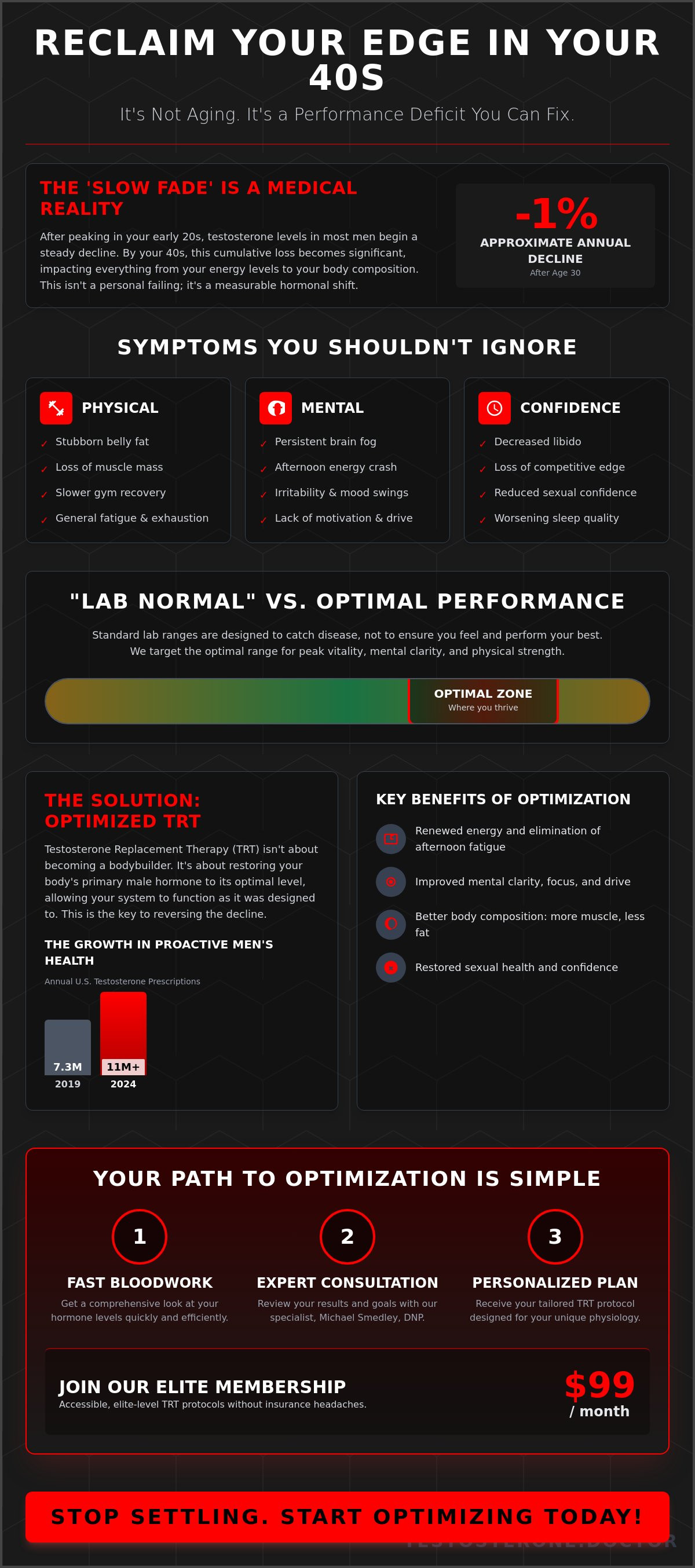
Here’s the hard data: after peaking in your late teens or early 20s, your body's testosterone production begins a steady decline. On average, this drop is about 1% per year starting around age 30. For a decade, you might not notice it. But by the time you hit your 40s, that cumulative loss becomes a tipping point. Suddenly, the changes are no longer subtle.
-
Physical Impact: You’re eating clean and hitting the gym, but the scale isn't moving. That stubborn belly fat seems permanently attached, and building or even maintaining muscle feels like an uphill battle.
-
Mental Impact: The sharp, decisive focus you relied on at work is now clouded by brain fog. Motivation wanes, and the "afternoon crash" becomes a daily ritual.
-
Emotional Impact: You feel more irritable, less patient, and your overall sense of well-being has taken a hit.
This isn't just "normal aging." While the decline is a natural process, living with the debilitating symptoms is a choice. Optimal hormone health means refusing to let an arbitrary number on a calendar dictate your physical and mental performance.
Why 'Toughing It Out' Is a Losing Strategy
Ignoring the signs of low testosterone is more than just a compromise on your quality of life; it's a gamble with your long-term health. Medically recognized hypogonadism—the clinical term for low T—is linked to a host of serious health risks that extend far beyond the gym or the bedroom.
Untreated low testosterone can contribute to:
-
Decreased Bone Mineral Density: Increasing your risk of osteoporosis and fractures later in life.
-
Cardiovascular Issues: Studies suggest a link between low T and an increased risk of heart disease.
-
Metabolic Syndrome: A cluster of conditions including high blood pressure, high blood sugar, and abnormal cholesterol levels.
-
Mental Health Decline: The psychological toll of low motivation, irritability, and brain fog can strain professional relationships and personal happiness.
The proactive man doesn't wait for a crisis. He anticipates challenges and takes strategic action. In 2026, taking a proactive stance on your hormonal health isn't just about feeling good today—it's about building a more resilient, healthier future.
The Science of Low T After 40: Symptoms You Shouldn't Ignore!
The symptoms of declining testosterone in your 40s are often insidious. They creep in slowly, masquerading as stress, burnout, or simply the cost of a busy life. But these markers are clear biological signals that your hormonal foundation is faltering. Recognizing them is the first step toward reclaiming your edge.
The most common signs can be broken down into three key areas:
-
Physical Markers: Persistent fatigue that sleep doesn't fix, an increase in body fat (especially around the abdomen), loss of muscle mass and strength, and reduced physical endurance.
-
Mental Markers: Difficulty concentrating or "brain fog," a noticeable drop in motivation and competitive drive, increased irritability or mood swings, and a general lack of focus.
-
Sexual Health Markers: A significant decrease in libido (sex drive), difficulty achieving or maintaining erections (Erectile Dysfunction), and a reduction in the intensity of orgasms.
For a more exhaustive breakdown, it's critical to look at the complete picture. Our detailed guide offers a comprehensive checklist to help you identify the specific ways low T might be impacting your life. Learn more in our article: Signs of Low Testosterone in Men Over 40: Your 2026 Health Checklist.
The 'Dad Bod' and Muscle Loss
Are you fighting a losing battle against the "dad bod"? You're not alone, and it's likely not your fault. Testosterone is a master regulator of body composition. It plays a crucial role in protein synthesis—the process your body uses to build and repair muscle tissue. It also directly influences fat metabolism, helping your body burn fat for energy.
When testosterone levels fall, this finely tuned system breaks down. Your body becomes less efficient at building muscle and more efficient at storing fat, particularly visceral fat around your organs. This is why even with a disciplined diet and consistent workout routine, you may see minimal results. Testosterone Replacement Therapy (TRT) restores this hormonal balance, making your efforts in the kitchen and the gym effective again. To complement these hormonal adjustments, it's also worth considering how nutritional factors like food sensitivities might be impacting your progress. Resources from Houston Medical Wellness Clinic explain how testing for food intolerances can provide a clearer path to achieving your weight loss and wellness goals.
Mental Edge and Professional Performance
Your career demands peak cognitive function. You need to be sharp, decisive, and resilient. Low testosterone directly undermines this by impacting neurotransmitter function in the brain. The "brain fog" you're experiencing isn't just a symptom of stress; it's a hormonal issue.
Many men in their 40s find their symptoms of low T overlap significantly with those of attention-deficit disorders. The inability to focus, lack of follow-through, and poor executive function can feel like a sudden onset of adult ADHD. For many, restoring hormone balance is the key to reclaiming their professional edge. If you're struggling with focus, it's worth exploring all the factors at play. Read more about this connection here: Adult ADHD Diagnosis in Layton: Reclaim Your Focus and Edge.
Standard 'Normal' Ranges vs. Optimal Performance: Which One Do You Want?
One of the biggest frustrations for symptomatic men is getting their bloodwork back only to be told their levels are "normal." This is where the conventional medical model fails ambitious men. The "normal" reference range for testosterone is incredibly wide (typically 300-1000 ng/dL) and is based on a statistical average of the entire male population—including sedentary, unhealthy, and elderly men.
Being "not technically sick" is not the same as being optimized for peak performance. At Testosterone.Doctor, we don't treat a piece of paper; we treat the patient in front of us. Your symptoms, goals, and quality of life are the primary metrics. We believe a 45-year-old man who wants to excel in his career and stay fit shouldn't have the same hormonal profile as an 80-year-old.
The Trap of the 'Normal' Lab Result
Why is a 400 ng/dL reading considered "normal" when you feel anything but? Because that lab range is designed to catch clinical disease, not to define optimal health. A 40-year-old man with a Total Testosterone level of 350 ng/dL may be told he's fine, yet he experiences all the classic symptoms of low T. Why? Because his level, while technically "in-range," is suboptimal for his age and lifestyle.
You wouldn't accept "average" performance in your career or your fitness goals. Why would you accept it for your hormonal health? We urge our patients to look beyond the number and focus on the outcome: symptom resolution and a return to a high-functioning state. If you feel off, something is off, regardless of what a generic lab report says.
Bioavailable T: The Only Number That Matters
Even the Total Testosterone number itself doesn't tell the whole story. Much of the testosterone in your bloodstream is bound to a protein called Sex Hormone Binding Globulin (SHBG). When testosterone is bound to SHBG, it's essentially "locked up" and unavailable for your body to use. The testosterone that is not bound, or is loosely bound to another protein called albumin, is known as Bioavailable Testosterone or Free Testosterone.
This is the testosterone that actually does the work—building muscle, improving focus, and driving libido. It's possible to have a "normal" Total T level but have high SHBG, resulting in low Free T and all the associated symptoms. This is why a comprehensive testing approach is non-negotiable. At our Layton clinic, we conduct a thorough hormone panel that gives us the full picture, allowing us to create a protocol that addresses the real root of the problem. Learn about our approach: Comprehensive Hormone Panel for Men in Layton: Stop Guessing, and Start Optimizing.
How TRT Works at Our Layton Clinic: Your Path to Optimization!
We've stripped away the bureaucracy and inefficiency of the traditional medical system to create a streamlined, effective path to hormone optimization. Our entire process is designed for busy, results-oriented men who value their time and demand expert care. Here’s how it works:
-
Step 1: Get Your Bloodwork. It starts with data. We offer fast, professional, and comprehensive hormone testing right here in Layton. No need for a referral, no waiting for weeks. We get you the answers you need, quickly.
-
Step 2: Consult with Our Medical Expert. You'll have a direct consultation with one of our expert medical providers. This is a collaborative process where we review your lab results, discuss your symptoms and goals, and design a personalized treatment plan.
-
Step 3: Choose Your Protocol. We tailor your therapy to your specific needs and lifestyle. Whether it's testosterone injections, cutting-edge peptides for recovery and fat loss, or other performance boosters, your protocol is built for you.
-
Step 4: Ongoing Monitoring and Adjustment. Optimization is a dynamic process. We conduct regular check-ins and follow-up bloodwork to ensure your hormone levels are in the "sweet spot" and that you're feeling the full benefits of your therapy.
Why Local Care Beats Online TRT Mills
In an era of telehealth, it can be tempting to opt for a national online TRT provider. We strongly advise against it. Hormone therapy is a serious medical treatment that demands professional, in-person oversight.
Online "TRT mills" often rely on cookie-cutter protocols, minimal medical supervision, and out-of-state providers who have never met you. This approach is not only less effective but can also be dangerous. At our Layton clinic, you benefit from:
-
Face-to-Face Medical Oversight: We conduct physical exams and have real conversations, allowing for a level of personalized care that's impossible to achieve through a screen.
-
Immediate Adjustments: Feeling off? Need to adjust your protocol? Simply stop by our office. There are no call centers or support tickets.
-
A Trusted Local Partner: We are part of the Layton community, accountable to our patients in a way that a faceless national company can never be.
Making the right choice for your care is paramount. See our guide on Choosing the Best Local TRT and Peptide Therapy in Layton to understand the difference.
Beyond Just Testosterone: Peptides and Performance
True optimization goes beyond a single hormone. We offer a comprehensive suite of performance-enhancing therapies that work synergistically with TRT to help you achieve elite results. This includes advanced treatments like Peptide Therapy, which can accelerate fat loss, improve recovery, and enhance muscle growth.
For those seeking the absolute pinnacle of performance, we also provide medically supervised performance medication protocols. This is a safe, legal, and effective way to achieve results that go far beyond what's possible with TRT alone, all under the guidance of a qualified medical professional.
Join Our $99/Month Exclusive Membership and Take Control Today!
Elite medical care shouldn't be complicated or prohibitively expensive. We've created an exclusive membership model designed for simplicity, transparency, and results. For just $99 per month, you get everything you need to take control of your health. No insurance games, no hidden fees, no nonsense.
Our membership includes:
-
Expert medical consultations and ongoing management of your protocol.
-
All necessary administrative support and priority care.
-
A direct partnership with a local Layton clinic dedicated to your performance.
This is your opportunity to stop the slow fade and start living at your full potential. Don't wait for your symptoms to get worse. Take the first step toward becoming the best version of yourself, right now.
The Most Affordable Elite Care in Layton
We've built our clinic around a simple principle: we work for you, not for an insurance company. By operating on a flat-rate, cash-pay model, we eliminate the red tape, delays, and arbitrary denials that plague the traditional healthcare system. This allows us to focus 100% on what matters—your results.
Our transparent pricing makes elite health optimization an affordable, sustainable lifestyle choice. It's a monthly investment in your energy, your career, your relationships, and your future.
Sign Me Up: How to Start Right Now!
Getting started is fast and easy. Use our secure online portal to enroll in our $99/Month Exclusive Membership today. We guarantee complete medical discretion and privacy. Your journey to reclaiming your edge begins with a single click. Don't put it off for another day.
SIGN ME UP! Join our $99/Month Exclusive Membership and Reclaim Your Edge Today!
Frequently Asked Questions (FAQs)
Is testosterone therapy safe for men in their 40s?
Yes, when prescribed and monitored by a qualified medical professional, TRT is a safe and effective treatment for men with clinically low testosterone. The key is proper medical supervision, which includes initial comprehensive bloodwork and regular follow-ups to monitor hormone levels, red blood cell counts, and other important health markers. The risks often associated with testosterone come from unsupervised abuse, not from medically guided therapy designed to restore levels to an optimal physiological range.
How long does it take to feel the benefits of TRT?
While every patient is different, many men begin to notice initial benefits within the first 2-4 weeks. Improvements in energy, mood, and libido are often the first to appear. More significant changes, such as increased muscle mass and decreased body fat, typically become more noticeable after 3-6 months of consistent therapy combined with proper diet and exercise.
Will TRT help me lose weight and gain muscle?
TRT is a powerful tool for improving body composition, but it is not a magic bullet. By restoring your testosterone to optimal levels, you are fixing the underlying hormonal issue that makes it difficult to burn fat and build muscle. Therapy makes your efforts in the gym and kitchen far more effective. Patients who combine TRT with a solid fitness and nutrition plan see the most dramatic and lasting results.
What are the side effects of testosterone therapy?
Potential side effects are managed through careful dosing and monitoring. They can include acne or oily skin, fluid retention, or an increase in red blood cell count (erythrocytosis). Our medical team carefully monitors your bloodwork to mitigate these risks and will adjust your protocol as needed to ensure your treatment is both safe and effective.
Do I have to stay on TRT forever?
Testosterone therapy is generally considered a long-term treatment. Because it supplements your body's natural production, stopping therapy will cause your testosterone levels to return to their previous low state, and your symptoms will likely reappear. The decision to stay on TRT is a lifestyle choice made in consultation with your provider to maintain your quality of life and performance long-term.
Can I get TRT if my levels are in the 'normal' range?
This is a key differentiator for our clinic. We treat the patient, not just the lab number. If you are experiencing clear symptoms of low testosterone, we will consider therapy even if your levels fall within the low end of the "normal" lab range. Our goal is optimization and symptom relief, not just keeping you from being technically classified as hypogonadal.
Why should I choose a local Layton clinic over an online provider?
Local care provides a level of safety, accountability, and personalization that large, impersonal online clinics cannot match. With a local provider, you get face-to-face consultations, physical exams, and the ability to make quick adjustments to your protocol. You are a patient, not a customer number.
How much does TRT cost at Testosterone.Doctor?
We offer a simple, transparent membership for $99 per month. This covers your expert consultations, ongoing protocol management, and all administrative support. The cost of medication is separate and varies based on your prescribed protocol, but we work to ensure it is as affordable as possible. There are no hidden fees or surprise bills.
Article by
Timothy Coltrin
Disclaimer
"Results May Vary" results are not guaranteed and will vary between individuals.